
Keep Netlify
- Static pages, forms, redirects. No process running overnight.


Netlify is strong when the page is built and then sits there. An API that runs all night, a database, a store release — different product. That is where Netlify stops.

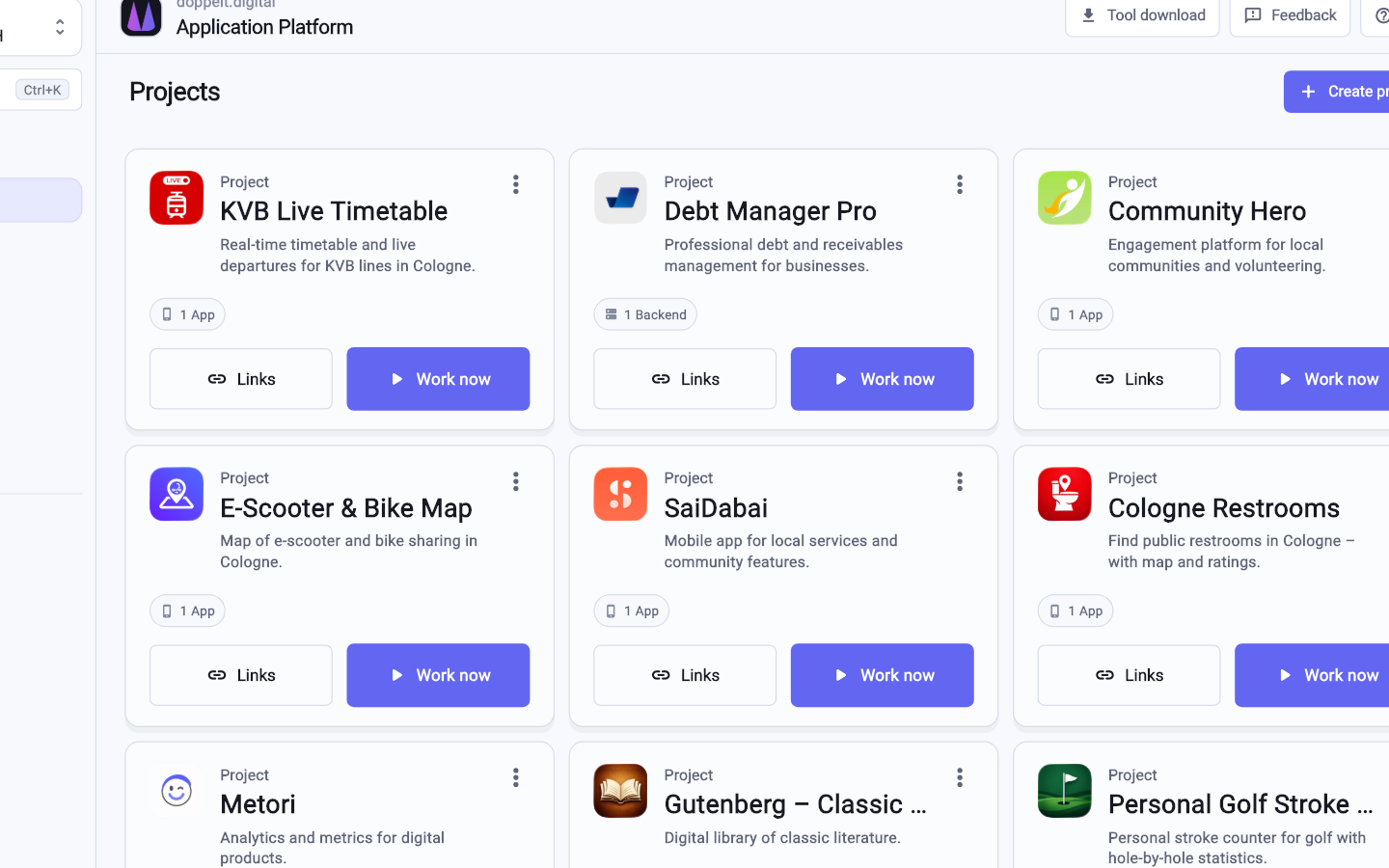
Netlify made Jamstack ordinary: git push, preview, done. That breaks when the site is only the shell and the core is a stateful service. Then you are not looking for a better Netlify — you need a place for the other parts.
This reflects the typical scope of both platforms. Details change over time, so check the current information from each provider when it matters.
| Criterion |
Application Platform
|
Netlify
|
|---|---|---|
| Static sites and Jamstack frontends | Fully covered: Hugo, Astro and Next.js through prepared pipelines | Fully covered: Core product, very mature and quick to set up |
| Global CDN and edge functions | Partly covered: Reverse proxy and SSL per server; no global edge network of its own | Fully covered: Worldwide CDN with edge functions as a central building block |
| Build plugins and ecosystem | Partly covered: GitLab CI jobs you can extend freely, but no plugin marketplace | Fully covered: Large catalogue of build plugins and integrations |
| Form handling without a backend | Partly covered: Handled by your own backend service, no ready-made form product | Fully covered: Form handling is part of the product |
| Long-running backend services | Fully covered: NestJS, Laravel and FastAPI as full services with a database | Partly covered: Serverless and edge functions, no long-running services |
| Databases and server baseline | Fully covered: Docker, databases, reverse proxy, SSL, firewall and backups are set up for you | Partly covered: Through third-party partners and integrations |
| Use your own servers | Fully covered: Your own server over SSH or a managed server from the platform | Not offered: Not supported, delivery runs on Netlify infrastructure |
| Building mobile apps | Fully covered: Flutter, Expo and native iOS and Android projects including build environments | Not offered: Not part of the product |
| Publishing to App Store and Play Store | Fully covered: Metadata, screenshots and versions through Fastlane from inside the platform | Not offered: Not part of the product |
| Remote development environments | Fully covered: Ubuntu workspaces with VS Code, JetBrains, RDP and VNC. iOS builds on the pipeline’s macOS machines | Not offered: Not part of the product |
| Where processing happens | Fully covered: Operated in the EU with a data processing agreement, servers freely selectable | Partly covered: US provider, processing under US law |
Green means fully covered, amber partly, grey not offered. Netlify is mature in the Jamstack space – the difference lies in how much of the chain each platform covers.
As of 9 September 2026. Based on the publicly documented feature scope of the providers named. Details can change; the provider’s current documentation takes precedence. Logos are trademarks of their owners and are used only to identify the product.
Netlify tiers by bandwidth and build minutes. Details are on the Netlify pricing page. We bill platform and servers as separate lines.
 Docker
 Databases
 Reverse proxy
 SSL
SSL
 Backups
 Firewall
 Kubernetes
 Monitoring
The migration happens step by step, with your existing repository as the foundation.
Your own server over SSH or a managed one. Docker, databases, reverse proxy, SSL, firewall and backups get configured.
Set up your project in the wizard and pick the stack. Repository, project structure and CI/CD pipeline are created with it.
Move your existing code into the repository. Environment variables and secrets live centrally in the project.
Domain, DNS and certificates are part of the setup. Once the pipeline is green, you point the DNS record over.
For building and deploying a static site, yes, and beyond that it covers more. What it does not bring is a global CDN of its own. If delivery speed to a worldwide audience is your key metric, a CDN still makes sense in front of the platform.
Yes. Hugo and Astro are among the templates and get built through a regular GitLab CI pipeline. The build command stays the same, only the place it runs changes. Steps such as linting or image optimisation you add yourself.
Both are tied to Netlify and need replacing when you move. Forms and small functions run in your own backend instead, for example NestJS, Laravel or FastAPI. That is extra work during the migration, but the logic and the data then belong to your code.
The platform runs on GitLab CI. Branch and merge request pipelines can be configured to deploy their own environments. Because the configuration lives in your repository, you decide which branches get one and for how long.
Netlify bills by usage, including bandwidth, build minutes and function invocations. On the Application Platform you pay for the platform and your servers. With steady traffic that makes the cost curve easier to predict.
A static site can stay on Netlify. The process behind it does not have to.