
Codespaces is enough
- GitHub is home anyway. Shipping is another team’s problem.

Codespaces removes local setup. After the push you are back to Actions, a hoster, Fastlane. We start the workspace in the same project that later owns the server and the store.

Entirely your call—we give you the ideal setup for both paths.
The setup app detects tools and starts everything with one click.
Ready-made dev environment—no local setup required.
Codespaces fixes setup pain: the repo opens ready. The next pain is that “ready” only means the IDE. If the same click should reach the server and the store, you need a different product, not another IDE.
The focus here is remote development. Details change over time, so check the current information from each provider when it matters.
| Criterion |
Application Platform
|
GitHub Codespaces
|
|---|---|---|
| Development environment in the cloud | Fully covered: Workspaces start fully configured, with no local setup | Fully covered: Core product, mature and quick to boot |
| Editors and ways in | Fully covered: VS Code, JetBrains, RDP and VNC through stable gateway URLs | Fully covered: VS Code in the browser and locally, JetBrains through Gateway |
| macOS environments for iOS builds | Partly covered: iOS builds and signing on the pipeline’s macOS machines. Interactive macOS workspaces come next | Not offered: Linux environments only |
| How the environment is defined | Fully covered: Project templates and platform configuration with tooling preinstalled | Fully covered: devcontainer.json in the repository, widely supported and portable |
| Connection to Git hosting | Fully covered: GitLab repositories, deploy keys and CI variables are created with the project | Fully covered: Very tight integration with GitHub repositories and pull requests |
| Project scaffolding from templates | Fully covered: Next.js, NestJS, Laravel, FastAPI, Flutter, Expo, Astro and Hugo as a ready project base | Not offered: Starts from an existing repository, does not create the project |
| CI/CD pipelines | Fully covered: GitLab CI configuration lives readably in the repository and can be changed | Partly covered: Not part of the product, CI runs separately through GitHub Actions |
| Deployment and hosting | Fully covered: Deploys to your own or managed servers, with Docker, SSL and backups included | Not offered: Not part of the product |
| Mobile apps and store releases | Fully covered: Flutter, Expo and native projects through to App Store, Play Store and Microsoft Store | Not offered: Not part of the product |
| Billing | Partly covered: Platform fee plus your servers, free to start without a credit card | Fully covered: Per-minute billing based on runtime and storage |
| Where processing happens | Fully covered: Operated in the EU with a data processing agreement, servers freely selectable | Partly covered: US provider, regions selectable, processing under US law |
Green means fully covered, amber partly, grey not offered. Codespaces is a mature development environment – the difference is everything that happens after the commit.
As of 9 September 2026. Based on the publicly documented feature scope of the providers named. Details can change; the provider’s current documentation takes precedence. Logos are trademarks of their owners and are used only to identify the product.
Codespaces bills compute hours. Current rules are in GitHub billing.
You can start with the workspaces and adopt the rest of the chain later.
Set up your project in the wizard and pick the stack. Repository, structure and CI/CD pipeline are created along with it.
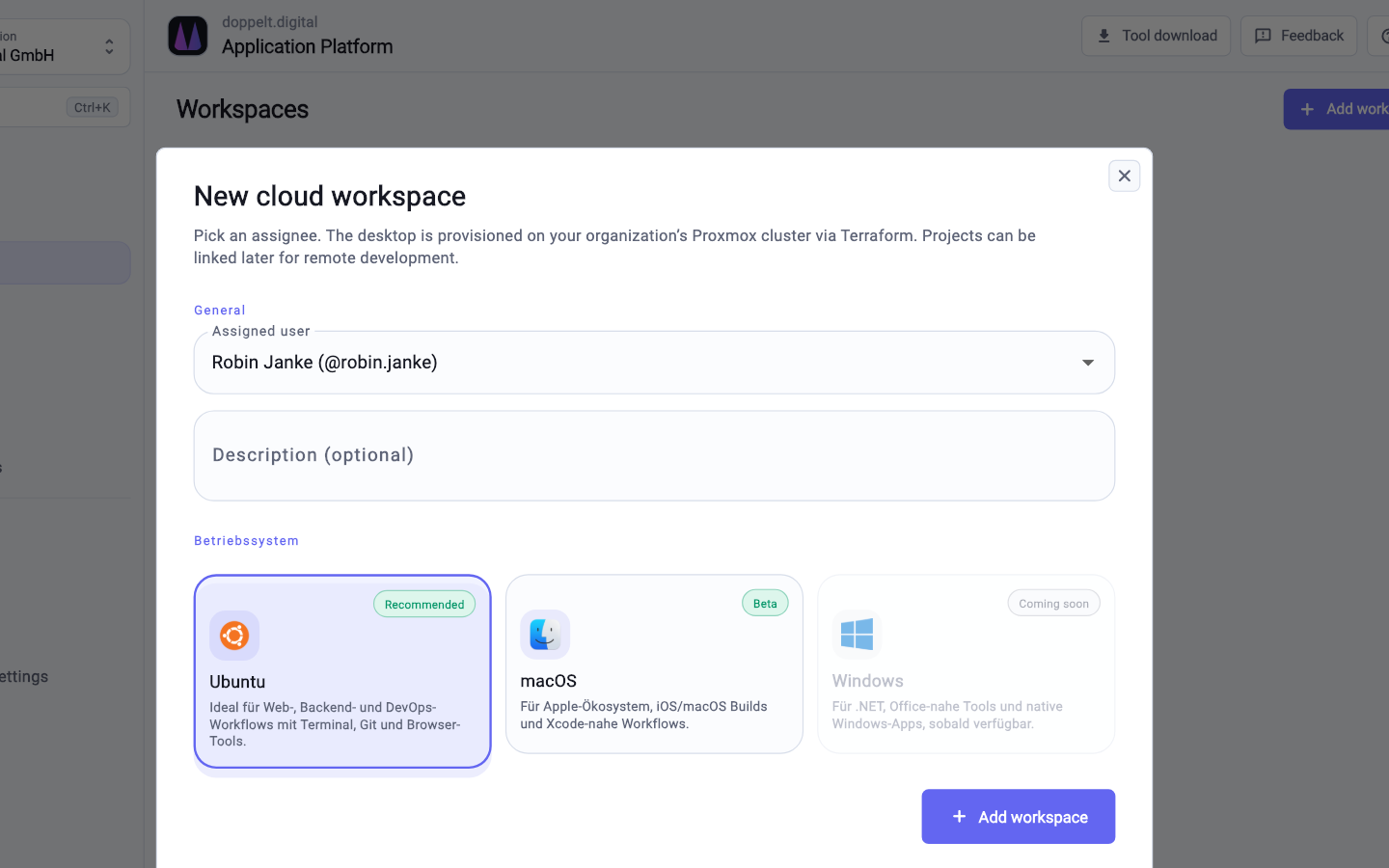
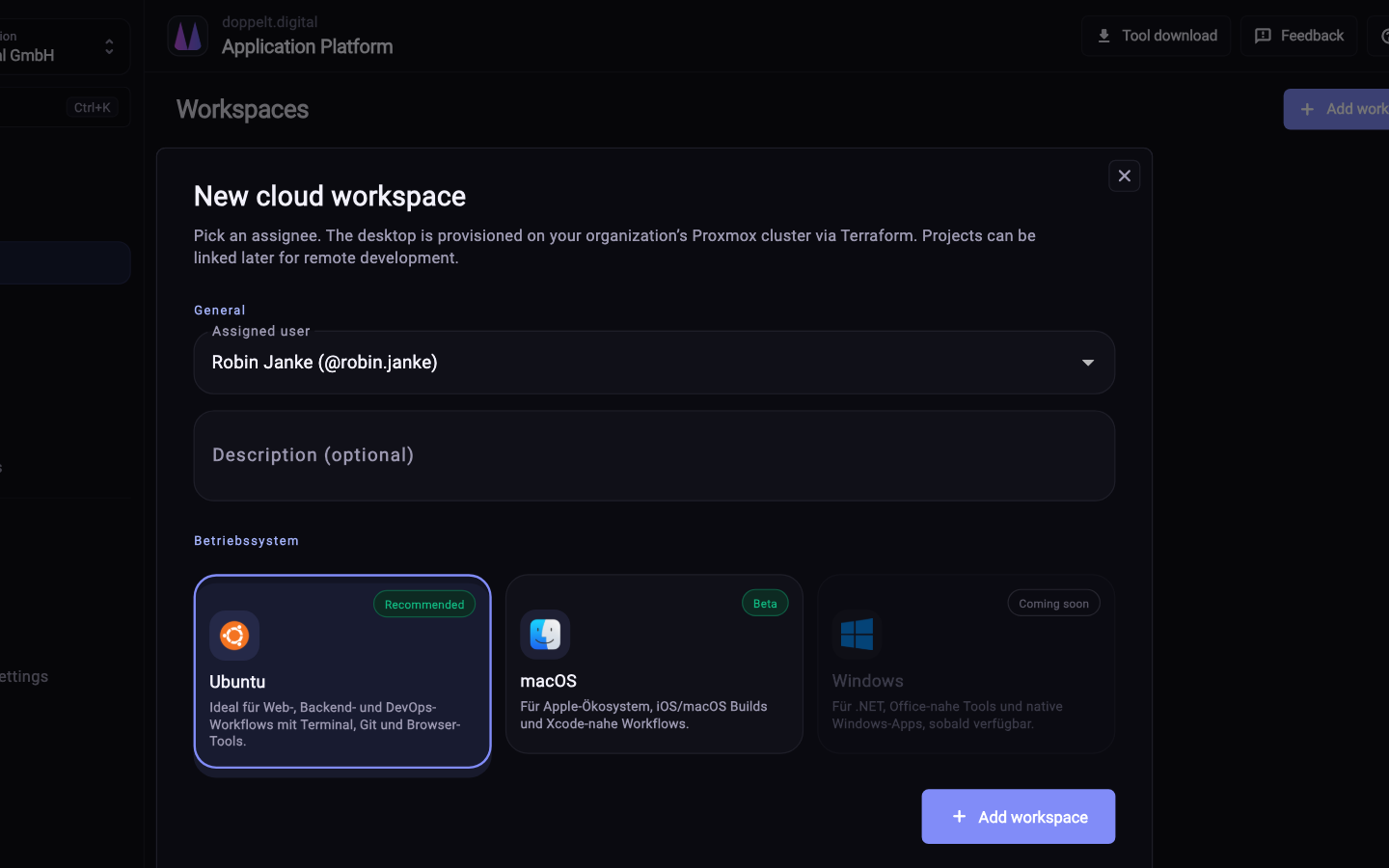
Start an Ubuntu workspace with VS Code, JetBrains, RDP or VNC. iOS builds run in the pipeline on the platform’s macOS machines; interactive macOS workspaces come next.
The GitLab CI configuration lives in the repository. Existing build steps can be carried over and adjusted.
Connect your own server over SSH or book a managed one, then add store releases for your mobile apps.
For the purpose of a cloud development environment, yes. Workspaces start fully configured and run through gateway URLs with VS Code, JetBrains, RDP or VNC. The difference: the environment belongs to a project with a pipeline, servers and releases.
Platform workspaces are provisioned from project templates and platform configuration rather than devcontainer.json. The idea stays the same: the environment is described and reproducible. Extra tooling can be added through project configuration.
iOS builds and code signing require macOS. Codespaces offers Linux only, so teams usually keep a separate machine for Apple releases. We provide macOS machines for the pipeline and publish to the App Store through Fastlane. Interactive macOS workspaces come next; under Workspaces you currently pick Ubuntu.
The platform works with GitLab repositories created at project start, including deploy keys and CI variables. Existing code moves across with its history; GitHub-specific workflows like Actions are the trade-off to weigh.
Codespaces bills per minute based on runtime and storage, cheap for occasional use. On the Application Platform you pay for the platform and your servers, with pipeline, deployment and store publishing included.
If another tool shows up after the commit, Codespaces is only half the answer.